

Battery Materials Recycling Market Expected to Reach New Heights at a 10.2% CAGR
Battery Materials Recycling Industry
By 2031, new batteries supplied in Europe must use at 16% recycled cobalt, 6% recycled lithium, and 6% recycled nickel, according to the EU Battery Regulation
Lead-acid batteries accounted for 65.5% of the Battery Materials Recycling Market in 2025, supported by decades-old collection infrastructure and near universal regulatory frameworks for lead recovery”
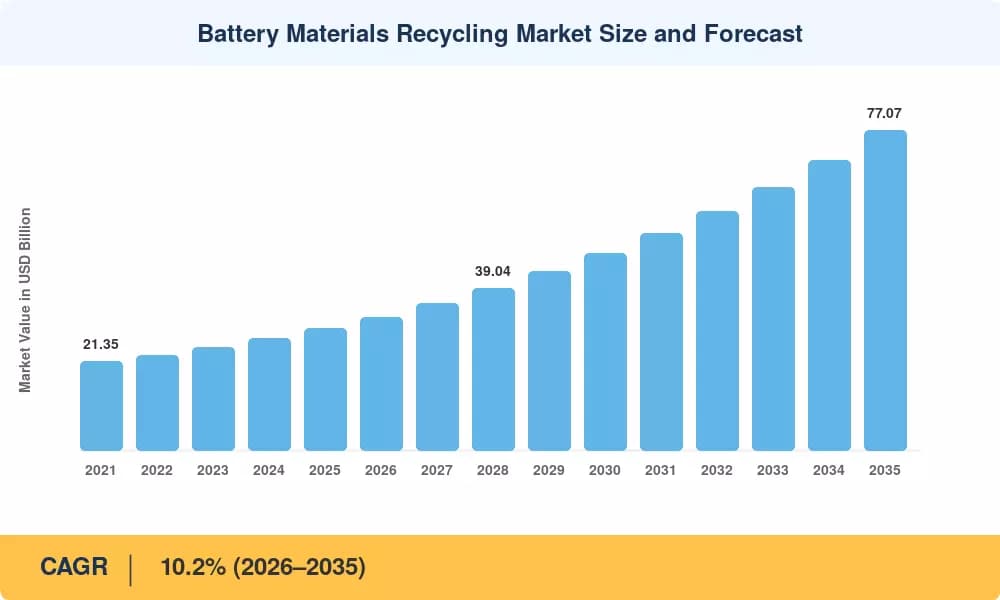
NEW YORK, NY, UNITED STATES, July 24, 2026 /EINPresswire.com/ -- The Battery Materials Recycling Market reached USD 29.30 billion in 2025 and is projected to grow from USD 32.15 billion in 2026 to USD 77.07 billion by 2035, registering a CAGR of 10.2% during the forecast period.— Prashant Hake
Market Overview
Battery materials recycling refers to the process of recovering valuable metals and materials from spent batteries, including lithium-ion, nickel-metal hydride, lead-acid, and nickel-cadmium batteries. The recycling process involves collection, sorting, disassembly, and various recovery techniques including pyrometallurgy (smelting), hydrometallurgy (chemical leaching), and direct recycling to extract critical materials such as lithium, cobalt, nickel, manganese, graphite, copper, and aluminum. These recovered materials can be refined and returned to the battery supply chain, reducing the need for virgin material extraction and creating a circular economy for battery materials. Battery recycling addresses both environmental concerns about battery waste and supply chain security for critical metals essential for the global energy transition.
The Battery Material Recycling market is experiencing exceptional growth driven by several key factors. The rapid proliferation of electric vehicles and portable electronics is generating substantial volumes of end-of-life batteries, creating a growing feedstock for recycling operations. The increasing demand for critical battery materials, coupled with supply chain vulnerabilities and price volatility, is making recycling an increasingly attractive source of materials. Stringent environmental regulations and extended producer responsibility requirements in many jurisdictions are mandating battery recycling and collection targets. The growing focus on circular economy principles and sustainability in the battery supply chain is driving investment in recycling infrastructure.
Key industry trends shaping the battery materials recycling market include the development of direct recycling technologies that preserve the cathode structure and enable higher recovery rates. The increasing investment in large-scale commercial recycling facilities, including gigafactory-scale operations, is expanding processing capacity. The growing importance of regional recycling capacity to reduce transportation costs and ensure supply chain security is driving facility development in major battery markets. The emergence of digital platforms and tracking systems for battery lifecycle management and recycling traceability is gaining momentum.
The market is also benefiting from technological advancements in recycling processes. Innovations in hydrometallurgical processes, including improved leaching and solvent extraction techniques, are increasing recovery rates and material purity. The development of robotic disassembly and automated sorting systems is reducing costs and improving operational efficiency. Advances in direct recycling, which avoids the energy-intensive breakdown and reconstitution of materials, offers potential for significant cost and energy savings.
Policy and regulatory frameworks are playing a crucial role in shaping the battery materials recycling market landscape. The European Union's Battery Regulation establishes collection targets, material recovery targets, and requirements for recycled content in new batteries. The US Inflation Reduction Act and Department of Energy initiatives are supporting domestic battery recycling infrastructure development. National regulations and extended producer responsibility programs in many countries are mandating recycling and collection obligations. Government funding programs and tax incentives for battery recycling infrastructure are accelerating market development.
The demand outlook for battery materials recycling is exceptionally strong, supported by the exponential growth in battery production, the increasing focus on supply chain sustainability, and the critical need to secure access to battery materials. The recycling of materials from end-of-life batteries and production scrap offers a significant opportunity to reduce the environmental impact of battery production and create a more sustainable and secure battery supply chain.
📍 Get Free Sample Report for Detailed Market Insights:
https://www.marketresearchfuture.com/sample_request/11461
Market Segmentation
By Battery Type: The market is segmented by battery chemistry including lithium-ion batteries, lead-acid batteries, nickel-metal hydride batteries, nickel-cadmium batteries, and other battery types. Lithium-ion battery recycling is the fastest-growing segment, driven by the rapid growth in EV and consumer electronics battery waste. Lead-acid battery recycling is a mature and well-established market with high recycling rates globally. Nickel-metal hydride recycling is supported by hybrid vehicle batteries, while nickel-cadmium recycling addresses industrial battery waste.
By Recycling Process: The market is categorized into pyrometallurgical processes (smelting), hydrometallurgical processes (chemical leaching), and direct recycling. Hydrometallurgical processes are gaining share due to their ability to recover multiple materials with high purity and lower environmental impact. Pyrometallurgical processes are well-established and widely used for the recovery of cobalt, nickel, and copper. Direct recycling is emerging as a promising technology offering higher efficiency and lower energy consumption.
By Source: The market is segmented by battery source including electric vehicles, consumer electronics, industrial batteries, and production scrap. Electric vehicle batteries represent the largest and fastest-growing source, driven by the increasing number of EVs reaching end-of-life and growing gigafactory production scrap. Consumer electronics contribute a steady stream of portable battery waste. Industrial batteries include stationary storage and backup power applications.
By Recovered Material: The market is segmented by recovered materials including lithium, cobalt, nickel, graphite, copper, aluminum, manganese, and other metals. Lithium and cobalt recovery commands premium value due to their criticality and price. Nickel recovery is significant for battery cathodes, while copper and aluminum are recovered from current collectors and casing materials.
By Region: The market is analyzed across North America, Europe, Asia-Pacific, Latin America, and the Middle East and Africa. Asia-Pacific is the largest market, driven by extensive battery manufacturing and consumption. Europe is the fastest-growing region, driven by strong regulatory frameworks.
🛒 You can buy this market report at:
https://www.marketresearchfuture.com/checkout?currency=one_user-USD&report_id=11461
Regional Analysis
North America: The North American battery materials recycling market is experiencing rapid growth, driven by the Inflation Reduction Act's incentives for domestic battery production and recycling, DOE funding, and the development of domestic recycling capacity. The United States leads the market, with significant investments in commercial-scale recycling facilities. Canada is developing recycling capacity, supported by its battery manufacturing and mining industry. The region's focus on supply chain security and domestic material production drives market development.
Europe: Europe is the fastest-growing market, driven by the EU Battery Regulation's ambitious targets for collection, material recovery, and recycled content. The regulation mandates that by 2035, recycled content in new batteries must include significant percentages of lithium, cobalt, nickel, and lead. Germany, France, Belgium, and the UK are leading countries with established and emerging recycling capacity. The region's strong environmental regulations and circular economy commitment support market growth.
Asia-Pacific: Asia-Pacific is the largest battery materials recycling market, driven by extensive battery manufacturing and consumption in China, Japan, South Korea, and India. China leads the market, with a well-established recycling industry and government policies promoting battery material recovery. Japan and South Korea have advanced recycling technologies and strong recycling industries. The region's significant EV adoption and battery production volumes generate substantial recycling feedstock.
Latin America: The Latin American market is in the development stage, with Mexico and Brazil emerging as key markets. Growing EV adoption and industrial battery consumption will create future recycling demand. The region's mining industry, particularly lithium and copper, may support recycling infrastructure development.
Middle East and Africa: The region presents nascent opportunities for battery materials recycling. South Africa is the primary market, with developing EV adoption and battery consumption. Infrastructure development and regulatory frameworks will shape future market growth.
Competitive Landscape / Key Players
The global battery materials recycling market is characterized by a mix of established recycling companies, battery manufacturers, and specialized material recovery firms. Key companies operating in the market include:
Umicore N.V.: A global leader in battery materials recycling, providing hydrometallurgical recycling services for lithium-ion batteries with high recovery rates. Umicore's integrated materials technology and sustainable solutions support its market leadership.
Glencore plc: A major mining and recycling company, offering recycling services for battery materials through its network of facilities. Glencore's integrated mining and recycling business model supports its market position.
Redwood Materials, Inc.: A US-based company specializing in lithium-ion battery recycling, focusing on recovering critical materials and building a circular supply chain. Redwood's partnerships with major automakers and expansion plans support its market presence.
Li-Cycle Holdings Corp.: A Canadian battery recycling company with a focus on lithium-ion battery processing. Li-Cycle's proprietary hydrometallurgical technology and expansion strategy contribute to its market presence.
GEM Co., Ltd.: A Chinese company specializing in battery recycling, processing significant volumes of lithium-ion and lead-acid batteries. GEM's scale and integration with battery manufacturing support its market position.
Other notable players include Saft, Aqua Metals, Cirba Solutions, Northvolt, and numerous regional recyclers and technology developers. Strategic developments include facility expansions, technology partnerships, and supply agreements with automakers and battery manufacturers.
Latest Industry News & Developments
December 2025: Redwood Materials announced the expansion of its Nevada recycling facility, doubling processing capacity to meet growing demand from electric vehicle manufacturers. The expansion includes advanced material recovery capabilities for lithium, cobalt, and nickel.
November 2025: Umicore and a major European automaker signed a long-term supply agreement for recycled battery materials, securing the supply of sustainably sourced lithium, cobalt, and nickel for the automaker's EV production.
October 2025: The European Commission approved funding for a multinational battery recycling infrastructure project, connecting recycling facilities across five European countries and establishing a coordinated approach to battery material recovery.
Market Challenges & Opportunities
Key Restraints: The battery materials recycling market faces challenges including the high capital and operating costs of recycling facilities, particularly for advanced hydrometallurgical and direct recycling processes. The variability in battery chemistries and pack designs complicates recycling processes. The logistics and safety challenges of transporting and processing spent batteries affect operational costs. The limited volumes of end-of-life batteries, particularly for the early generations of EV batteries, affect facility utilization. Price volatility of recovered materials and competition from primary mining affect economic viability.
Emerging Opportunities: The battery materials recycling market presents substantial opportunities in the growing EV battery recycling sector. The development of direct recycling technologies offering higher efficiency and lower costs creates competitive advantages. The integration of recycling with battery manufacturing through closed-loop systems offers supply chain security and sustainability benefits. The expansion of collection infrastructure and regulatory mandates will increase recycling feedstock availability. The recovery of critical materials from production scrap in gigafactories creates additional feedstock opportunities.
Future Potential: The long-term potential of the battery materials recycling market is exceptional, underpinned by the exponential growth in battery production, the critical need to secure materials supply, and the imperative to create a circular battery economy. Continued technological innovation and scale will reduce recycling costs and improve recovery rates. The development of standardized battery designs and improved recyclability will enhance economic viability. The essential role of recycling in ensuring sustainable battery supply chains and achieving climate goals ensures sustained market momentum and significant growth potential throughout the forecast period.
To explore more market insights, visit us at:
https://www.marketresearchfuture.com/reports/battery-materials-recycling-market-11461
Final Market Summary
The global Battery Materials Recycling market is poised for exceptional growth, with projections indicating an expansion from USD 32.15 billion in 2026 to USD 77.07 billion by 2035, at a CAGR of 10.2%. This robust growth is driven by the rapid proliferation of electric vehicles, the increasing demand for critical battery materials, stringent environmental regulations, and the growing focus on circular economy principles and supply chain security. Asia-Pacific leads as the largest market, while Europe represents the fastest-growing region, driven by ambitious regulatory frameworks. Technological advancements in hydrometallurgical and direct recycling processes are enhancing recovery rates and cost-effectiveness. Despite challenges including high capital costs and feedstock variability, the market offers substantial opportunities in EV battery recycling, direct recycling technologies, and closed-loop systems. The essential role of battery recycling in securing sustainable material supply chains and enabling the global energy transition ensures sustained market momentum and long-term growth potential throughout the forecast period.
More Related Reports from MRFR Library:
Crop Sprayer Market https://www.marketresearchfuture.com/reports/crop-sprayer-market-2867
Cargo Shipping Market https://www.marketresearchfuture.com/reports/cargo-shipping-market-3165
India Color Sorter Market https://www.marketresearchfuture.com/reports/india-color-sorter-market-3569
Mechanical Hand Tools Market https://www.marketresearchfuture.com/reports/mechanical-hand-tools-market-3602
Sanding Pads Market https://www.marketresearchfuture.com/reports/sanding-pads-market-3705
Grinding Machinery Market https://www.marketresearchfuture.com/reports/grinding-machinery-market-3753
Food Service Equipment Market https://www.marketresearchfuture.com/reports/food-service-equipment-market-3776
Boiler System Market https://www.marketresearchfuture.com/reports/boiler-system-market-3816
Multi Tasking Machine Tools Market https://www.marketresearchfuture.com/reports/multi-tasking-machine-tools-market-4072
Industrial Dust Collector Market https://www.marketresearchfuture.com/reports/industrial-dust-collector-market-4226
Larry Wilson
WantStats Research And Media Pvt. Ltd.
+ +1 855-661-4441
email us here
Visit us on social media:
LinkedIn
Facebook
YouTube
X
Legal Disclaimer:
EIN Presswire provides this news content "as is" without warranty of any kind. We do not accept any responsibility or liability for the accuracy, content, images, videos, licenses, completeness, legality, or reliability of the information contained in this article. If you have any complaints or copyright issues related to this article, kindly contact the author above.
