

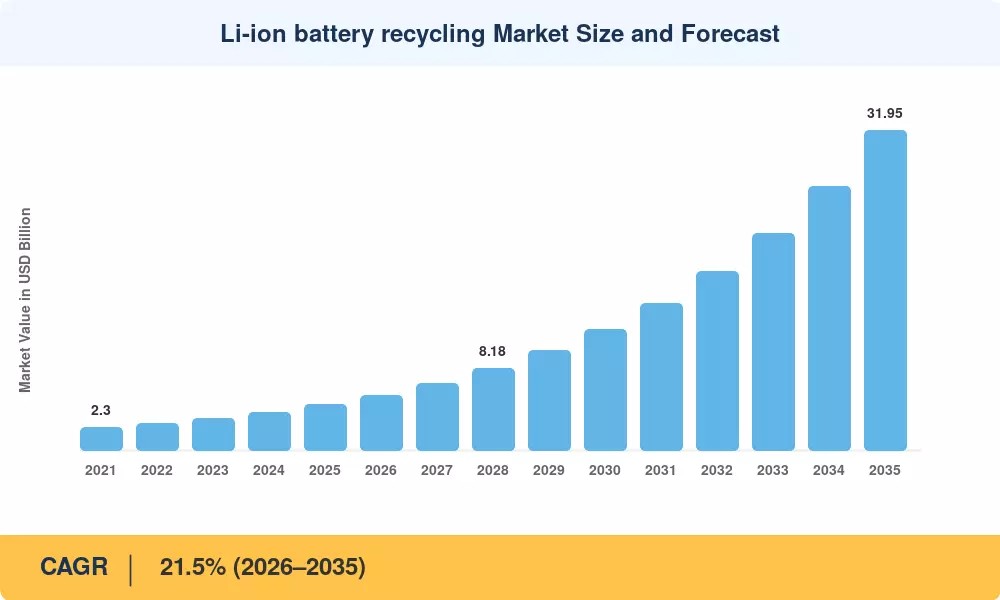
Lithium-ion Battery Recycling Market to Reach USD 31.95 Billion by 2035 at 21.5% CAGR.
Lithium ion Battery Recycling Industry
Hydrometallurgical processes held 58.4% of the Lithium-ion battery recycling market in 2025, driven by higher lithium recovery rates than thermal alternatives.
Automotive batteries held a 68.1% share of the Lithium-ion Battery Recycling Market in 2025, as first-wave EV packs entered retirement in China and Europe.”
NEW YORK, NY, UNITED STATES, July 24, 2026 /EINPresswire.com/ -- The Lithium-ion Battery Recycling Market was valued at USD 4.56 Billion in 2025 and is projected to grow from USD 5.54 Billion in 2026 to USD 31.95 Billion by 2035, registering a CAGR of 21.5% during the forecast period (2026–2035).— Prashant Hake
Market Overview
Lithium-ion battery recycling industry refers to the industrial processes of recovering valuable materials—including lithium, cobalt, nickel, manganese, and copper—from spent lithium-ion batteries and manufacturing scrap. These processes encompass collection, dismantling, mechanical shredding, black-mass production, and chemical refining through hydrometallurgical or pyrometallurgical methods. The recovered battery-grade materials are reintegrated into new battery production, establishing closed-loop supply chains that reduce dependence on virgin mining and minimize environmental impact.
Growth Drivers
Two powerful catalysts underpin the market's exceptional growth trajectory: the accelerating wave of EV battery retirements and stringent regulatory mandates. Early cohorts of mass-market electric vehicles sold between 2015 and 2018 began reaching end-of-life in 2024-2025, sending an estimated 280,000 tonnes of battery packs into global collection systems. This wave is expected to intensify from 2027-2030 as vehicles sold during the 2019-2022 growth spurt reach retirement.
Regulatory frameworks are transforming battery recycling from a voluntary sustainability initiative into a compliance-driven necessity. The EU Battery Regulation, effective February 2024, mandates minimum recycled-content thresholds for cobalt, lithium, and nickel starting in 2031, with collection targets of 63% by 2027 and 73% by 2030. The U.S. Inflation Reduction Act links EV tax credits to domestic-content requirements, channeling substantial capital toward onshore recycling capacity. China mandates 65% recycling of power batteries by 2025 through a digital traceability system, while South Korea requires 80% collection by 2028.
Industry Trends & Technological Developments
The industry is witnessing a decisive shift toward hydrometallurgical processes, which recover high-value metals with far greater precision than conventional smelting. These water-based refining technologies achieve recovery rates exceeding 99% for nickel, cobalt, and manganese. Direct-material recycling techniques are emerging as an innovative alternative, preserving active battery materials in their original state to reduce energy consumption and enhance reuse efficiency.
The production and trade of black mass—an intermediate material for further metal extraction—is gaining momentum, with smaller recyclers increasingly supplying black mass to larger hydrometallurgical refiners. Automation-driven sorting innovations and AI integration are optimizing processing efficiency, while companies are modernizing facilities to improve recovery rates and reduce environmental impact.
Policy & Regulatory Influence
Beyond the EU and U.S. frameworks, India has emerged as a significant policy driver. In September 2025, the Union Cabinet approved a ₹1,500 crore Incentive Scheme under the National Critical Mineral Mission to develop domestic recycling capacity for lithium-ion batteries and e-waste. The scheme offers 20% capital expenditure subsidies and operational expenditure incentives over six years, targeting the creation of at least 270 kilo-tonnes of annual recycling capacity and approximately 40 kilo-tonnes of annual critical mineral production.
The EU Battery Regulation's fines of up to 4% of annual turnover for non-compliance are compelling automakers to finance reverse logistics networks. Volkswagen allocated €200 million in March 2025 to integrate 1,200 dealerships and 350 third-party collection sites.
Demand Outlook
The demand outlook remains exceptionally strong, driven by surging EV adoption—global electric car sales increased 35% year-over-year in 2023. BloombergNEF estimates that global investment in battery recycling capacity topped USD 8 billion between 2022 and 2024, with at least 35 commercial-scale facilities either commissioned or under construction. As first-generation EV batteries reach end-of-life in volume, throughput constraints—not demand—will likely become the binding variable for growth.
📍 Get Free Sample Report for Detailed Market Insights:
https://www.marketresearchfuture.com/sample_request/10583
Market Segmentation
The Lithium-ion Battery Recycling Market is comprehensively segmented to capture diverse industry dynamics and application requirements.
By Battery Chemistry
Nickel Manganese Cobalt (NMC): Held approximately 50-70% market share in 2025, driven by dominance in long-range EVs and high cobalt content sustaining favorable recycling economics. Lithium Iron Phosphate (LFP): The fastest-growing segment, deployed by Tesla and BYD in standard-range vehicles, though zero-cobalt composition erodes intrinsic value. Lithium Cobalt Oxide (LCO): Remains lucrative in laptops and smartphones, but shrinking device footprints cap tonnage. Nickel Cobalt Aluminum (NCA) and Lithium Manganese Oxide (LMO): Niche applications in high-performance or long-cycle applications.
By End-of-Life Source
Automotive Batteries: Accounting for approximately 63-65% of revenue in 2025, expected to expand at a 25%+ CAGR as EV cohorts retire. Manufacturing Scrap: Provides steady, chemistry-homogeneous feedstock supporting rapid ramp-up of recycling plants. Consumer Electronics: Lags due to fragmented collection and "drawer hoarding" of devices. Industrial/Energy Storage Batteries: Growing with ESS deployment for grid stabilization.
By Recycling Technology
Hydrometallurgical: The preferred option offering precise recovery of lithium, cobalt, and nickel with over 99% efficiency. Pyrometallurgical: Traditional smelting processes, commercially mature but with lower precision. Direct/Mechanical Recycling: Emerging technology preserving active material integrity.
🛒 You can buy this market report at:
https://www.marketresearchfuture.com/checkout?currency=one_user-USD&report_id=10583
Regional Analysis
North America
North America currently leads the global lithium-ion battery recycling market with an estimated 35.4% share of global revenue. The U.S. dominates the regional market with approximately 86.5% share, driven by the Inflation Reduction Act's domestic-content requirements for EV tax credits and Department of Energy loan guarantees exceeding USD 2 billion. Federal initiatives, including DOE grants and investments under the Bipartisan Infrastructure Law, aim to reduce reliance on imported critical minerals and improve supply chain resilience. Key players such as Redwood Materials and Cirba Solutions are expanding domestic capacity.
Europe
Europe holds the second-largest share at roughly 23-28% of the global market, anchored by the EU Battery Regulation's stringent producer-responsibility mandates. The region's focus on circular economy practices, decarbonization, and battery material self-sufficiency is accelerating investment in recycling infrastructure. Northvolt's Revolt plant and Umicore's Belgian and German facilities exemplify European leadership. Volkswagen's €200 million commitment to integrate collection networks underscores automaker engagement.
Asia-Pacific
Asia-Pacific is the fastest-growing regional market, expanding at approximately 23.8% CAGR as Chinese and South Korean cell makers internalize recycling within their gigafactory complexes. The region generated approximately 44.6% of global revenue in 2025, buoyed by China's 65% recycling mandate and Brunp Recycling's 120,000-tonne annual capacity. India's ₹1,500 crore Incentive Scheme for Critical Mineral Recycling, launched in September 2025, aims to develop domestic capacity and reduce import dependency. Key players include CATL (through subsidiary Brunp), GEM Co., and Attero Recycling.
Rest of the World
South America holds approximately 4% of the market but is rising as lithium-rich nations launch domestic recycling pilots. The Middle East and Africa claim around 3%, with expansion potential through regional hubs and incentives tied to solar-plus-storage installations.
Competitive Landscape / Key Players
The Lithium-ion Battery Recycling Market is moderately fragmented, characterized by vertically integrated players, specialized recyclers, and emerging technology providers.
Key Companies
Umicore (Belgium): A global materials technology and recycling group operating one of the world's most sophisticated precious metal recycling facilities, with operations across 30 countries. Glencore (Switzerland): Among the world's largest recyclers of nickel-bearing and cobalt-bearing materials, with over 150 mining & metallurgical sites and 90 offices in 50 countries. Redwood Materials (US): A U.S.-based leader recycling, refining, and remanufacturing battery materials, with partnerships including Ford, Panasonic, Audi, and Volkswagen. Contemporary Amperex Technology Co., Ltd. (CATL / Brunp Recycling) (China): Through subsidiary Guangdong Brunp Recycling Technology, offers entire battery industrial chain recycling with 120,000 tons per annum capacity and over 99% recovery rates. GEM Co., Ltd. (China): Operates five waste power battery comprehensive utilization centers, handling more than 250,000 tons of waste power battery packs annually. Cirba Solutions (US): Formed through strategic mergers, now the largest lithium-ion battery recycler in North America with six processing locations. Attero Recycling (India): An electronic asset management company with strong presence in South Korea, Australia, India, and Hungary.
Strategic Developments
Key players are employing multiple strategies to strengthen market presence. Companies are investing heavily in hydrometallurgical capacity to improve recovery rates and reduce environmental impact. Long-term supply agreements with EV manufacturers and battery producers are securing consistent waste streams. In September 2023, Redwood Materials acquired Redux Recycling GmbH to expand European presence. Collaboration with government agencies is unlocking funding and regulatory support for large-scale recycling initiatives. In March 2024, 24M Technologies introduced Liforever, an innovative direct-material recycling technique preserving active material integrity.
Latest Industry News & Developments
India Launches ₹1,500 Crore Critical Mineral Recycling Scheme: In September 2025, the Union Cabinet approved the Incentive Scheme under the National Critical Mineral Mission, offering 20% Capex subsidy and Opex incentives over six years to develop domestic recycling capacity for lithium-ion batteries and e-waste. The scheme targets 270 kilo-tonnes of annual recycling capacity and 40 kilo-tonnes of critical mineral production.
EU Battery Regulation's Expanded Producer Responsibility Takes Effect: The regulation, effective February 2024, mandates minimum recycled-content thresholds for cobalt, lithium, and nickel from 2031, with collection targets of 63% by 2027 and 73% by 2030, underpinned by fines of up to 4% of annual turnover for non-compliance.
CATL's Brunp Recycling Expands Capacity: Guangdong Brunp Recycling Technology operates waste battery disposal capacity of approximately 120,000 tons per annum with recovery rates exceeding 99%, serving a recycling network covering China, Japan, South Korea, and the Americas.
Market Challenges & Opportunities
Key Restraints
Volatile Metal Prices: The 85% crash in lithium carbonate prices between March 2024 and December 2025 dragged black-mass prices down, forcing some recyclers into negative margins and compressing profitability. High Reverse-Logistics Costs: Transporting spent batteries ranges from USD 150-250 per tonne due to hazmat classification (UN 3480) requiring fire-resistant packaging and state-of-charge testing. Regional Over-Capacity: In some markets, capacity expansion has outpaced feedstock availability, creating scarcity risk and margin pressure.
Emerging Opportunities
Automaker Take-Back Programs: OEM initiatives such as GM's Ultium warranty eliminate consumer friction and secure consistent feedstock streams. Direct Recycling Technologies: Innovations like 24M Technologies' Liforever preserve active material integrity, reducing energy consumption and enhancing reuse efficiency. Closed-Loop Supply Chains: Tesla reports that 92% of critical minerals in its 4680 cells can be recovered and looped back into new batteries, validating the economic case for circularity. Regulatory-Driven Capacity Expansion: Government initiatives worldwide—including the U.S. DOE grants, EU mandates, and India's ₹1,500 crore scheme—are creating substantial investment opportunities for recyclers and technology providers.
To explore more market insights, visit us at:
https://www.marketresearchfuture.com/reports/li-ion-battery-recycling-market-10583
Final Market Summary
The Lithium-ion Battery Recycling Market is positioned for exceptional growth, with projections indicating a near-sevenfold increase from USD 4.56 billion in 2025 to USD 31.95 billion by 2035, at a robust CAGR of 21.5%. This extraordinary expansion is driven by the accelerating wave of EV battery retirements, stringent regulatory mandates including the EU Battery Regulation and U.S. Inflation Reduction Act, and technological advancements in hydrometallurgical and direct recycling processes. While challenges such as volatile metal prices, high logistics costs, and regional capacity constraints persist, emerging opportunities in automaker take-back programs, closed-loop supply chains, and government-backed recycling initiatives offer significant potential for industry participants. The future market landscape will be defined by companies that successfully scale operations, achieve high recovery rates, secure consistent feedstock, and navigate evolving regulatory requirements across multiple jurisdictions.
More Related Reports from MRFR Library:
Industrial Batteries Market: https://www.marketresearchfuture.com/reports/industrial-batteries-market-1631
Smart Gas Meter Market: https://www.marketresearchfuture.com/reports/smart-gas-meter-market-1686
Distributed Control System Market: https://www.marketresearchfuture.com/reports/global-distributed-control-system-market-1698
Genset Market: https://www.marketresearchfuture.com/reports/genset-market-1709
Well Test Market: https://www.marketresearchfuture.com/reports/well-test-market-1715
XLPE Cable Market: https://www.marketresearchfuture.com/reports/xlpe-cables-market-1750
Power Distribution Cables Market: https://www.marketresearchfuture.com/reports/power-distribution-cables-market-1767
Overhead Power Cables Market: https://www.marketresearchfuture.com/reports/overhead-power-cables-market-1782
Power Boilers Market: https://www.marketresearchfuture.com/reports/power-boilers-market-1795
Load Bank Market: https://www.marketresearchfuture.com/reports/load-bank-market-1802
Larry Wilson
WantStats Research And Media Pvt. Ltd.
+ +1 855-661-4441
email us here
Visit us on social media:
LinkedIn
Facebook
YouTube
X
Legal Disclaimer:
EIN Presswire provides this news content "as is" without warranty of any kind. We do not accept any responsibility or liability for the accuracy, content, images, videos, licenses, completeness, legality, or reliability of the information contained in this article. If you have any complaints or copyright issues related to this article, kindly contact the author above.
